
France 2027 Is Already a Two-Horse Race
On Polymarket: Next French Presidential Election ↗With Bardella dominating round-one polls and Philippe closing fast in head-to-head runoff data, a 24% YES price is pricing in a level of chaos the current signals simply don't support.
Current view — April 14
The French political conversation has spent the better part of two years pretending that 2027 is still wide open. It is not. What the polls are now showing, consistently, is a race that has shed its noise and settled into a recognisable skeleton: Jordan Bardella as the dominant first-round force, Édouard Philippe as the man best placed to stop him in round two, and everyone else arguing over who gets to finish third. We think markets are still pricing the old version of this story, the chaotic one, and that is why the spread looks wrong to us.
Start with Bardella. His favorability rating sits at 42 points — a full six ahead of Philippe, and more than double anyone else in the field. That kind of lead at this stage of a cycle does not evaporate by election day; it hardens into a first-round result. The question is no longer whether he leads after round one, but by how much.
🥇 J. Bardella : 42% +1
🥈 M. Le Pen : 37%
🥉 E. Philippe : 36% +8
—
⏫️ Fortes hausses
E. Ciotti : 25% +5
F. Ruffin : 19% +4
F. Roussel : 17% +6
F. Hollande : 17% +4
J-L. Mélenchon : 15% +4 pic.twitter.com/VNbk4u3Ldu
Philippe's position is structurally different but equally real. The most recent head-to-head runoff polling puts him ahead of Bardella by four points, and the movement over a single survey cycle has been substantial — Bardella closed five points in one go. That trend is what the market should be watching, not the current gap. A five-point swing in one cycle means the runoff is genuinely competitive rather than a foregone conclusion, and it means Philippe cannot coast on his current numbers.
Presidential runoff election
Philippe (HOR-RE): 52% (+5)
Bardella (RN-PfE): 48% (-5)
+/- vs. 19-20 November 2025
Fieldwork: 25-26 March 2026
Sample size: 812
➤ https://t.co/qOzl2nSVPC pic.twitter.com/eY4qL6eqHI
The left's collapse is the quiet engine of everything else in this analysis. Mélenchon leads left-wing intentions but does so at a level that would have been considered a disaster in any previous cycle — down to 12% in recent polling, while Glucksmann has shed three and a half points to sit at 10%. There is no path from those numbers to a second-round berth. The left is not merely fragmented; it is absent from the decisive part of the contest.
🔻 Mélenchon | 12% (+1)
🟨 Glucksmann | 10% (-3,5)
🟩 Tondelier | 5% (-1)
🟥 Roussel | 2% (-1) pic.twitter.com/0D7d5h737f
Some market participants have leaned on the theory that the entire centrist and centre-left space is in terminal decline — that the bloc between PS and LR has been losing double-digit shares of the vote at every election since 2012 and will simply not be competitive. We find this argument too linear. Philippe's recent surge is not a blip; it reflects a consolidation of non-RN voters who have nowhere else to go once the left implodes. The dynamic the secular-decline thesis describes was real during the Macron ascendancy; it is less obviously applicable to a post-Macron landscape where the presidential centre is being rebuilt under new management.
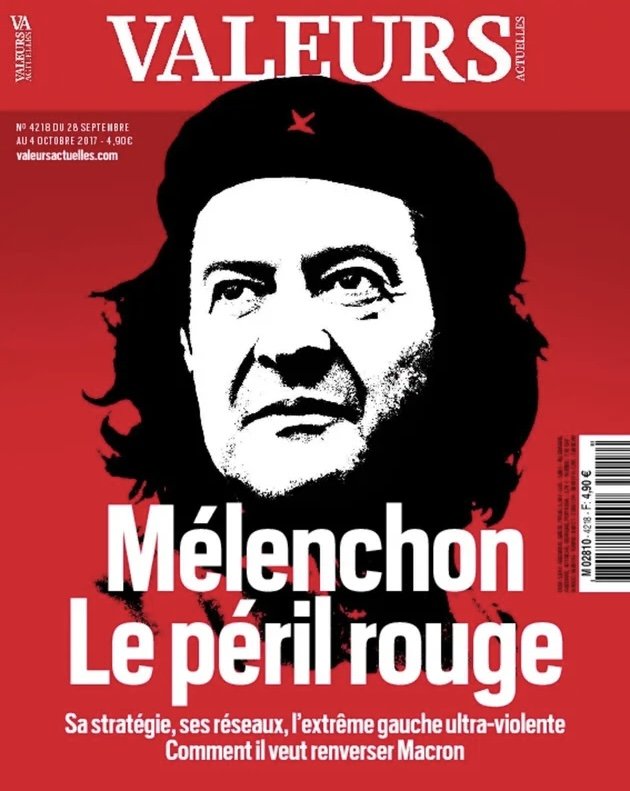
There is one variable we are watching without yet being able to price it: Gabriel Attal. One sharp observer in this market describes him as navigating the wreckage of Macronism with unusual skill, having quietly rebranded the presidential party he leads. Attal is not a frontrunner by any current polling measure, but he is the kind of figure who benefits from a crowded and exhausted field. His presence is a reason for some caution on a clean two-horse narrative, not a reason to abandon it.
The race will not stay this tidy all the way to April 2027. Candidacies will be announced, scandals will land, and coalition dynamics will shift. But the underlying architecture — Bardella versus one centrist in round two, with the left as a spectator — is more durable than a 24% price implies.